AI has been around for quite some time now and just when we started to get all cosy with our voice assistants and a bit of AI presence here and there, the new and advanced Generative AI made a super dramatic mainstream entrance with ChatGPT last November, with around 100 million users in the first two months – a figure that took Facebook four and a half years to reach.
The New York Times ambitiously called it ‘our Promethean moment’ and probably, rightly so with all the hype around the generative AI.
What is generative AI?
Generative AI is a type of artificial intelligence that can create new content, such as text, images, or music. It does this by learning from existing data and then using that data to generate new, similar data (as defined by Google Bard 😊).
Unlike its predecessor, generative AI doesn’t work on black and white, it’s all the grey in between, dealing with higher complexity of output with more than one solution.
What does it mean for creative professionals?
The assumed blueprint for AI technology was always automation of operational and logical tasks, with creativity being the exclusive privilege that only humans would enjoy. We were certainly not ready for the massive paradigm shift. All hell broke loose when generative AI started to write, compose poems, tunes, and art with merely some text inputs (prompts) – suddenly making us question our relevance. Even fine art competitions have started to entertain AI generated creatives (not surprised after seeing NFTs finding place in museums).
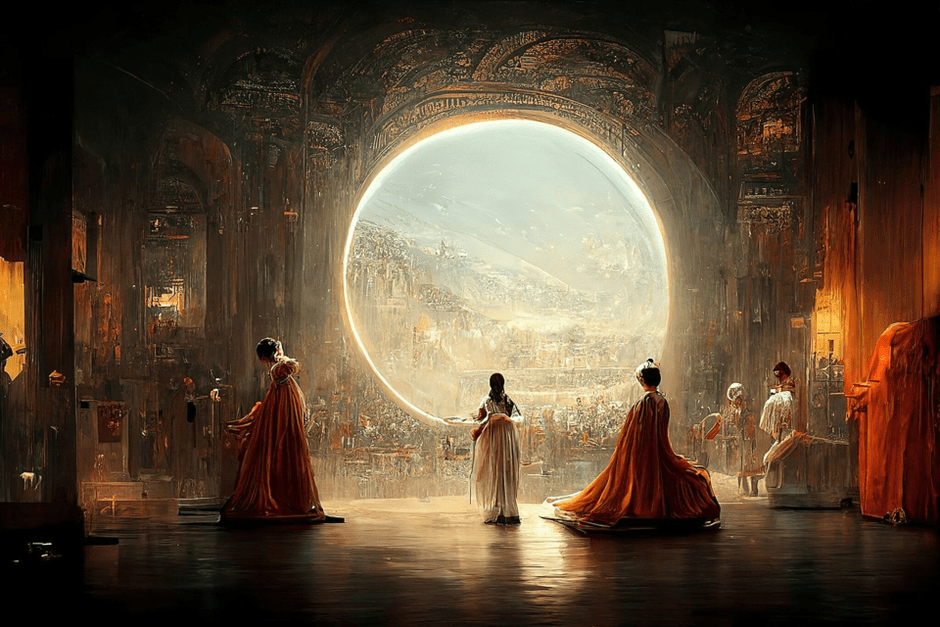
win an award in an art competition, sparking debate in the creative community about AI induced
high-tech plagiarism
Brands like Unilever, Cadbury have already started using machine learning and generative AI to create ads (Ogilvy must be rolling in his grave). Cosmopolitan became the first magazine to have an issue cover created by AI-based image generation tool.
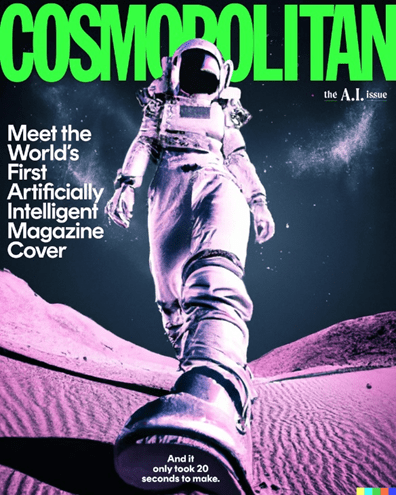
The conversations around being replaced by machines isn’t a new one. Every time there has been a new technology, such speculations have arisen. And as the history suggests, with every technological advent, there have been realignments of how we work, leading to newer opportunities. Generative AI is no different.
So, is it really AI vs humans?
‘I can do it better than AI’ – honestly, this is, by far, the lamest (and a very common) comparison that I have ever seen when it comes to technology.
One thing that we are not realizing is that generative AI is not here to create masterpieces (inputting a string of text in a software to generate Starry Nights would have definitely mortified Van Gogh). It is here for the mass creative production and to feed the constant demand of content. Generative AI is a tool to be leveraged to enhance productivity and efficiency. Using AI doesn’t mean that we are outsourcing thinking and creativity entirely to the machines.
Other critical part is the integrated thinking – defining what all to use, when, where and how to integrate the output from various models to reach the final result – definitely a major soft skill for the future.
I read somewhere ‘if you don’t want to be replaced by a machine, stop working like one’. Generative AI has democratized creativity. With a layman now being able to create content and designs, it has become apparent for the creative professionals to bring the authenticity and originality in their work. Human insights based on real life experiences still define the impact of a creation. Personally, my best work has always come out from my personal experiences, travel, books I read, conversations (and hopefully would continue to do so).
Generative AI is an impact multiplier, and certainly not a replacement for human mind. Machines still need human interventions, just that the current scenario requires re-defining our approach for the solutions.
Limitations
Generative AI is comparatively a very new technology and the fast maturing didn’t leave much scope of coping with the flaws and limitations.
Hallucinations remain the biggest issue with the technology. Although platforms like Google Bard put a disclaimer about the authenticity of the information, ChatGPT mentioning the last data update on a particular topic, our high hopes from the technology often misled us in extracting the information. We need to be mindful that its not a search engine, it’s a thought engine.
Bias has been another pain point for generative AI. The data sets on which these models are trained lack diversity. A couple of months ago, most of the text-to-image generation tool (including Canva and Midjourney) interpreted business person as white male. Adobe Firefly has made some impressive improvements but still a long way to go.
AI is not error free. Now imagine, the flawed AI tagging the data which forms the base of these generative AI models. As per a report published by MIT Technology Review, the task of tagging, to be done manually, has also been assigned to AI which has increased the probability of error further.
Due to lack of regulations and transparency, the output cannot entirely be trusted. Adoption of generative AI has led to massive lawsuits, mostly related to plagiarism. With lack of clarity and any tangible policy in place, the risk issues are high.
In case you are planning to integrate generative AI in your work, one level of scrutiny of the output is a must. It is a great tool, but yet to be evolved for authenticity and tackle risk management.
What’s next
The evolution of generative AI has been unbelievably fast. With the mass content production, we need more initiatives like Adobe’s CAI (Content Authenticity Initiative) for transparency and tools like SynthID – a watermarking tool by Google DeepMind for AI generated images and MIT’s PhotoGuard to keep a check on authenticity and avoid AI manipulation.
Another interesting thing to look out for is the smaller and more compressed AI model that could be accessed offline and deployed across devices including smartphones, XR headsets and Internet of Thing (IoT) devices. How it’s going to impact the creative professionals – its yet to be seen.
With tool evolutions like ChatGPT integrating Canva plug-in and Adobe Firefly coming out of beta, we are already set for the next step in the roadmap of generative AI. Professional services firms like EY have already started adding generative AI to their bouquet of services.
We are still confused about the generative AI and conversations around the interactive AI has already begun.
Love it or hate it, AI is the present and the future.

 The Creative Lens