
Have you observed a recent shift in tech? Tech bros are hijacking the MET Gala, grey t-shirts and blue denims are getting replaced with sharp suits, VCs are posting mood-boards, AI companies are obsessing over cinematic launch videos, and ‘vibes’. Wonder why?
For years, Silicon Valley obsessed over speed and efficiency. Ship fast. Scale faster. Break things. Now suddenly, everyone is talking about taste. The industry that once dismissed design as decoration is now realizing that in a world where technology is abundant, taste has become differentiation – a superpower.
A lot of experts are calling this new obsession taste-washing* – making taste a performance instead of a perspective.
Still, one could sense a real shift happening.
As AI has commoditized execution, creative judgment matters more; the demand for individuality and originality has surged. Anyone can generate visuals in seconds, but knowing what to make is becoming more valuable than simply knowing how to make it.
That’s why taste might be the biggest flex for creative professionals right now.
Taste is pattern recognition. Context. Intent. Restraint. Strategy. Knowing why one design feels timeless while another feels instantly disposable. It’s built from curiosity and experience of the real world, not prompts.
The challenge here – unlike technical skills, acquiring taste is a slow and meticulous process with no straight guideline or a timeline.
Over the years, some tricks worked for me personally that helped me not only to develop my personal design style but also created a sort of ‘muscle memory’ for eyes and brain for sharpened awareness – some of them listed below:
- Be more observant: Study why certain layouts, films, campaigns, or objects make you feel something. Feel free to dismantle the designs you see, even the bad ones. That will help you understand why certain styles just don’t work.
- Build references outside graphic design: One of the mistakes designers make is to restrict themselves with one discipline. Move beyond your respective field to understand the larger pictures. Fashion, architecture, cinema, music, photography, literature – taste grows at intersections.
- Develop self-awareness: The one that takes longest time to build. Explore your personal style rather than getting swayed by what’s simply popular right now. Your design shall depict your personality, not something picked from the internet.
- Build strategic mindset: No more a choice. Taste isn’t just aesthetics; it’s understanding context, audience and timing. Future of design is not just about the output; it’s about the intent.
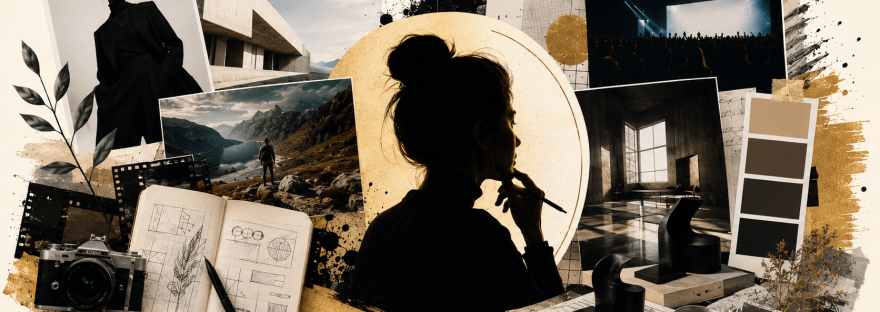
- Spend time in the real world: Piyush Pandey, one of the greatest Ad men of India, said it in an interview that stayed with me – “If you look in your screen, you will only see data; if you see beyond your screen, you will see the world.” Algorithms flatten perspective. Culture doesn’t only live on Behance, Pinterest and Instagram. Curate what you like. Click pictures. I personally love collecting innovative packaging, cards, magazines; and for all the pictures I take during my travels, I put them on my personal country-wise mood-boards (Adobe Boards is a convenient tool for digital curation).
- Protect your curiosity: The best creatives are always learning, always observing and trying to build stories never told before.
The irony is that techies spent a decade trying to automate creativity, only to rediscover that human judgement was the most valuable part all along. 😊
*Taste-washing is when companies borrow the language and aesthetics of culture without deeply understanding the craft behind it. Minimal branding, expensive campaigns, artsy collaborations, carefully curated feeds — all signaling cultural sophistication while the underlying thinking stays shallow. Taste becomes performance instead of perspective.
The term was coined by Kyle Chayka, author and staff writer for the New Yorker’s articles in the early 2024, who later expanded in his book ‘Filterworld: How Algorithms Flattened Culture’.


